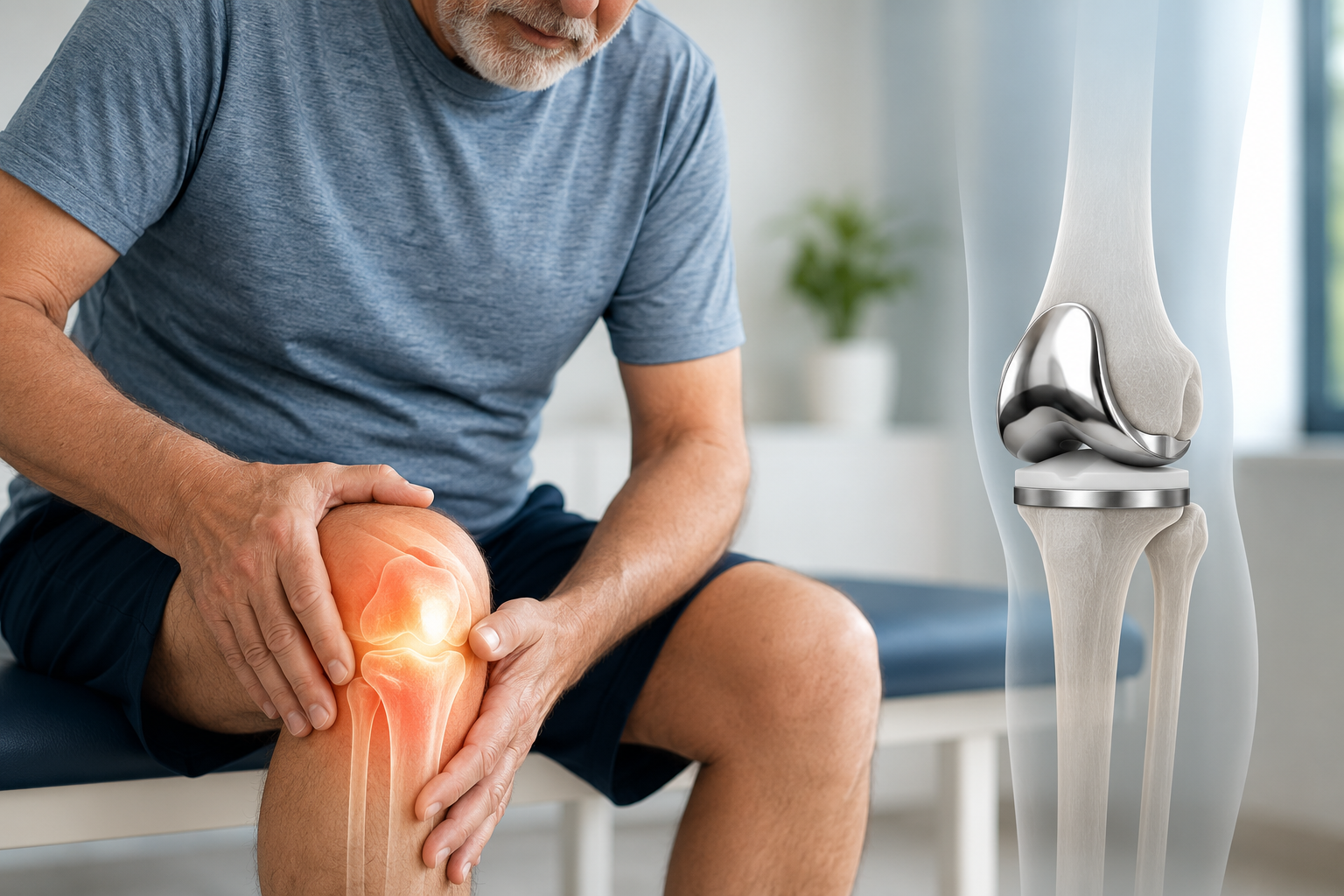
Understanding Knee Arthritis
Knee arthritis occurs when the smooth cartilage covering the ends of the bones gradually wears away. As the cartilage becomes thinner, bones begin to rub against each other, causing:
- Persistent knee pain
- Stiffness
- Swelling
- Difficulty walking
- Reduced mobility
- Bow-legged or knock-kneed deformity
- Loss of independence
Over time, simple activities such as climbing stairs, getting up from a chair, or even sleeping comfortably can become increasingly difficult.
When Should You Consider Knee Replacement?
You may be a suitable candidate if you experience several of the following:
Persistent Pain
Your knee pain is present most days and is no longer adequately relieved by medicines or rest.
Difficulty Walking
Walking even short distances becomes painful, and you increasingly rely on a stick or walker.
Pain at Night
Pain interrupts your sleep or persists even while resting.
Failure of Conservative Treatment
Despite appropriate treatment — including medications, physiotherapy, weight management, injections, and activity modification — you continue to have significant symptoms.
Loss of Independence
Routine daily activities such as climbing stairs, shopping, travelling, or participating in family and social events become difficult.
X-rays Show Advanced Arthritis
Your clinical symptoms match imaging findings that demonstrate severe joint damage.
Signs That You May Be Waiting Too Long
Many patients postpone surgery because of fear or misinformation. Waiting excessively can sometimes make surgery and recovery more challenging. You may be delaying treatment if:
- Your walking distance is becoming progressively shorter
- You avoid social outings because of pain
- You depend on painkillers every day
- Your knee is becoming increasingly bent or deformed
- You have stopped enjoying activities you once loved
- Pain is affecting your sleep and overall well-being
Living with unnecessary pain can reduce your fitness, muscle strength, and confidence, all of which are important for recovery after surgery.
Is There an Ideal Age for Knee Replacement?
There is no fixed age for knee replacement. Some patients require surgery in their 50s because of severe arthritis or previous injuries, while others manage well into their 70s or 80s with conservative treatment.
The decision depends on:
- Severity of arthritis
- Pain levels
- Functional limitations
- Overall health
- Lifestyle and activity goals
Should You Wait Until the Pain Becomes Unbearable?
No. Modern knee replacement aims to restore mobility and improve quality of life — not simply relieve unbearable pain.
Patients who undergo surgery at the appropriate time often experience:
- Better mobility
- Easier rehabilitation
- Improved muscle strength
- Faster return to daily activities
- Better overall satisfaction
Waiting until the knee becomes severely deformed or muscles become significantly weakened may prolong recovery.
Benefits of Modern Robotic Knee Replacement
For suitable patients, robotic-assisted knee replacement offers several advantages:
- Highly accurate implant positioning
- Personalised surgical planning
- Better soft tissue balancing
- Smaller bone resections where appropriate
- Improved joint function
- Faster early recovery in many patients
- Potential for greater patient satisfaction
Robotic technology complements the surgeon's expertise and helps deliver precise, individualised treatment. Read more about the advantages of robotic knee replacement.
When Surgery May Not Be Needed
Not every painful knee requires replacement surgery. Many patients benefit from:
- Lifestyle modification
- Weight reduction
- Physiotherapy
- Activity modification
- Pain-relieving medications
- Knee braces
- Joint injections
- Joint preservation procedures
A thorough assessment helps determine the most appropriate treatment for each individual.
How Is the Decision Made?
Choosing knee replacement is a shared decision between you and your surgeon. During your consultation, I consider:
- Your symptoms
- Clinical examination
- X-rays and other investigations
- Previous treatments
- General health
- Personal expectations and lifestyle
Only after carefully discussing all available options do we decide whether surgery is the right choice.
Frequently Asked Questions (FAQs)
Am I too young for knee replacement?
Age alone is not the deciding factor. The severity of your symptoms and arthritis is far more important.
Am I too old?
Many healthy patients in their 70s and even 80s enjoy excellent results following knee replacement after appropriate medical assessment.
Will I need both knees replaced?
Not necessarily. Some patients require only one knee replacement, while others may benefit from staged surgery if both knees are severely affected.
How long does recovery take?
Most patients begin walking within a day of surgery. Recovery continues over several months, with many returning to routine daily activities within 6–12 weeks, depending on their overall health and rehabilitation.
How long does a modern knee replacement last?
With modern implants, improved surgical techniques, and appropriate patient care, many knee replacements continue to function well for 15–20 years or longer, although longevity varies from person to person.
If I need surgery, who will actually perform it?
Dr. Anand Jadhav performs every operation personally. Assisting staff may support the procedure, as is standard in any operating theatre, but the surgery itself is never delegated to another surgeon.
Don't Let Knee Pain Control Your Life
If knee pain is preventing you from enjoying your family, work, hobbies, or daily activities, it may be time to seek expert advice. Early assessment allows us to explore all available treatment options and determine whether non-surgical care or knee replacement is the best solution for you.
Why Choose Dr. Anand Jadhav?
- 30+ Years of Orthopaedic Experience
- 12 Years NHS (United Kingdom)
- Consultant Orthopaedic Surgeon
- Robotic Joint Replacement & Arthroscopy Specialist
- Personalised, Evidence-Based Care
- Advanced Robotic Knee Replacement
- Comprehensive Rehabilitation Guidance
📞 Book your consultation — call 904 905 0990 or visit us at London Joints Clinic, Wanawadi or Jupiter Hospital, Baner, Pune.